Showing posts with label physics. Show all posts

Sunday, December 15, 2024

On The Beginning of Infinity

Here's my review of "The Beginning of Infinity," a book that touches on many of my interests. Its author advocates a philosophy that's much closer than that espoused by the author of the previous book I blogged about.


The Beginning of Infinity: Explanations That Transform the WorldThe Beginning of Infinity: Explanations That Transform the World by David Deutsch
My rating: 5 of 5 stars

The Beginning of Infinity presents a strong thesis about the importance of explanatory knowledge and its relationship to limitless progress. I’d heard Deutsch talk about this topic before, and I had assumed this would be yet another typical nonfiction book belaboring the same points. A friend whose tastes I respect recommended I read it anyway, so I gave it a try. I’m very glad I did!

The books thesis in clearly laid out, and the arguments for it are very persuasive. Deutsch confronts many possible philosophical objection, and attempts to obliterate each one by using very general arguments. He convincingly takes on inductivism, empiricism, justificationism, relativism, instrumentalism, and of course post-modernism, among many other philosophies. In fact, his arguments against other philosophies are probably stronger than his argument for his own thesis, but I think that still fits with the main worldview of the book: that progress requires replacing mistaken ideas.

Deutsch reinforced many of my views on some topics (eg the existence of objective values) and convinced me of some others (on why political compromise is bad). Even in parts of the book where I found him less convincing (eg in his defense of the many-worlds interpretation of quantum mechanics or his views on AI), I feel I still learned something and have more to ponder.

I also appreciated Deutsch’s fearlessness. For example, he doesn’t buy into environmental sustainability and is willing to buck most academics on sacrosanct topics. You know where Deutsch stands and why. Go read this book if you have any interest in the philosophy of science and of human progress.

View all my reviews

Monday, December 21, 2015

Why Does the World Care about Our Math?

One day while working on bandit problems at Yahoo!, I had this strange realization that its search engine, nay the entire world, seems have a particular remarkable property: we can sit around doing math, and as a result, better advertisements will get served to users.  Of course, this applies not just to computational advertising, but to pretty much anything -- we can know where the planets will be, when certain epidemics will spread, how fast planes need to fly to stay airborne, and a plethora of other things just by thinking abstractly and solving some equations.

I immediately and eagerly shared my newfound realization with others, and it impressed absolutely nobody.  I was told "How else would the world work?" and "There is lots of math that's not useful, but we choose to work on and formalize the things are are relevant to the real world."  These are, of course, perfectly good objections, and I couldn't explain why I found my realization at all remarkable, but I'd had a nagging feeling that I was onto something.

Forward 6 years, and I'm at Market Fresh Books, a bookstore near UIC.  As an aside, this bookstore is really interesting -- it sells used books by the pound or for small flat fees. I even once picked up a copy of baby Rudin for just 99¢ (plus tax) to add to my library.  Anyhow, I stumbled upon a copy of "Disturbing the Universe," Freeman Dyson's autobiography from 1979, and it looked interesting enough to buy.  That evening, while reading it, I came upon the following passage by Dyson:
"Here was I ... doing the most elaborate and sophisticated calculations to figure out how an electron should behave.  And here was the electron ... knowing quite well how to behave without waiting for the result of my calculation.  How could one seriously believe that the electron really cared about my calculation one way or the other?  And yet the experiments ... showed it did care.  Somehow or other, all this complicated mathematics that I was scribbling established rules that the electron ... was bound to follow.  We know that this is so.  Why it is so, why the electron pays attention to our mathematics, is a mystery that even Einstein could not fathom."
I still don't know the answer, and I can't even state the question without it seeming silly, but at least I now know I'm in good company.

Freeman Dyson
image credit, atomicheritage.org

Monday, August 16, 2010

An Awful Waste of Space?

It's been 50 years since Frank Drake (of the famous Drake equation) started project Ozma -- humanity's first search for signals from alien intelligent life. I thought it might be fun to post on this topic, even though I have absolutely no expertise in it.

In 1950, ten years prior to project Ozma, Enrico Fermi posed a question that might have inspired Drake: if intelligent aliens exist, why haven't we found them (or they us) yet? This question is actually worth thinking about, for the following reasons:
  1. Earth is probably not the only planet in the entire universe on which intelligent life evolved. It's likely that (the building blocks of) life can form in many diverse conditions. There's probably even more evidence for these claims now than there was in 1950.
  2. Once there's life, evolution should take care of producing intelligent life (at least in some cases).
  3. Intelligent life would probably start explore the universe and expand at, perhaps, an exponential rate (hey, the universe is pretty big).
  4. So much intelligent life, going all about the universe, you'd think they would have run into us by now! (Or at least sent us some messages)
But of course, despite looking, we haven't yet found anything.  So, why not?

Here's a list of all the (remotely plausible) reasons I can think of, from least to most likely. I realize the events are not all mutually exclusive.
  • [very unlikely] Intelligent life is all over the place. But once aliens invent true virtual reality or something else that really floats their boat (and they always do), they have no good reason to go exploring the universe.
  • [very unlikely] Intelligent life is everywhere, and different aliens often run into each other. However, whenever this occurs, the more advanced aliens wipe out the less advanced ones. By the anthropic principle, we'll have to wait to be the more advanced ones.
  • [unlikely] Intelligent life has already found us on Earth but we don't know it. Either it is successfully hiding from us (more likely) or the government is successfully hiding its signals from us (much less likely).
  • [unlikely] Intelligent life occasionally appears, but always (or usually) manages to wipe itself out with the weapons it invents before getting the chance to meet us humans.
  • [possible] We are alone and very special. Intelligent life, has not appeared anywhere else. The reason we are even around to ask this question is the anthropic principle, God's will, or plain old extreme luck.
  • [reasonable chance] There is life all over the universe, but either it doesn't expand exponentially or the distances are just too great to cover, both for both intelligent beings and their signals.
  • [reasonable chance (most likely)] There are intelligent beings emitting signals that reach us from afar, but using methods (or languages) we haven't though of. Eventually, we'll figure it out and our world will change forever.
I'm sure I missed something, so I welcome your comments.

The image of the Very Large Array at Socorro, New Mexico, United States is under a Creative Commons Attribution-Share Alike 2.0 Generic license. Its author is here.

After writing this post, I have found a similar list on Wikipedia's article on the Fermi Paradox.

Monday, May 17, 2010

Lessons from Future Past

After reading Isaac Asimov's 1950 novel Pebble in the Sky, I started thinking about what visions of the future people had around 50 years ago. While reading the book, I was particularly struck by a mundane passage where one character (Arbin) waits for his turn at the newspaper. This passage wouldn't have been jarring to me had the book's setting not been thousands of years in Earth's future, where spaceships routinely traversed the galaxy. Asimov (at least in this book) imagined people passing a newspaper around in an age of interstellar travel. This reminded me of Captain Kirk signing notepads brought to him by his crew or Princess Leia hiding messages in droids. Just send an email!

But who can blame people for imagining the future this way? The 50s and 60s followed an exciting time in physics -- in the preceding half-century, we had gone from searching for the ever-unfindable aether to discovering relativity and quantum mechanics, inventing televisions and the atomic bomb, and much more. Fusion power providing unlimited free energy was supposed to be just around the corner. Meanwhile, computer science was still in its early stages -- we sent a man to the moon still doing some calculations with slide rules. What happened in the next half a century blindsided everyone.

To be fair, physics has made its own remarkable advances since then (in ways people imagined) -- in everything from incredible materials to new and interesting theoretical developments. But in the last half-century, the real action was in computing. Some visionaries did foresee the rise of computers. But instant and universal access to information? Secure virtual payments? Zettabyte scales? Nobody saw that coming! People envisioned a Golden Age for spaceships and jetpacks, yet got one in computing first.

That some of our predictions would turn out wrong is of course expected, but I still can't help wonder what the next 50 years will bring. There's a near consensus that these advances will continue, that we'll spend more and more time online and computers will do more and more for us. And it's hard for me not to believe that this will help Golden Ages in other fields -- in medicine, now that we can quickly sequence genomes, run studies at unprecedented scales, and take advantage of nanotechnology; in math, as computers become more useful and we collaborate in new ways to solve open problems; even social sciences, as researchers get data they couldn't have dreamed of. Perhaps computers will even start to develop dreams of their own.

And while I think continued breakthroughs in computer science await (How can I not? I'm a computer scientist!), it's useful to remember that our predictions have never been perfect. Who knows where the next exciting advance will actually lie -- it might even be fusion reactors.

Tuesday, May 11, 2010

Around the Galaxy in 80 Years

Stephen Hawking recently wrote a fun article on time travel. One of Hawking's ideas is to build a giant spaceship and fill it with fuel. As the ship burned the fuel, it would go faster and faster, eventually reaching speeds near the speed of light. Hawking argued that we could use such a ship to travel to the future or to the edge of our Galaxy, perhaps in only 80 years.


Leaving aside my skepticism about our ability to do that sort of thing, a bigger question should be -- how would that even help? It seems impossible to get to the edge of our Galaxy in 80 years no matter how fast we go. The Milky Way is thousands of light years in diameter. Even going at the speed of light, crossing it would take thousands of years, so what could Hawking be talking about?

The answer is again relativity. In my previous post, I talked about how objects going near the speed of light experience relativistic effects. One of those effects is time dilation: clocks of moving objects go slower when viewed by (relatively) stationary observers. Another is Lorentz contraction: an observer will measure the length of a moving object as shorter in the direction of its relative motion.

So while we can't hope to go faster than the speed of light, we wouldn't really have to traverse thousands of light years either, at least not from our point of view. Because of Lorentz contraction, we would see the entire galaxy contract into a more manageable distance. So, in some sense, we can travel a light year in under a year. And if we then turn around and come home to Earth, we will also have traveled into the future, killing two birds with one giant fuel-filled spaceship.

This also answers the question from my previous post. From their point of view, muons halve only thrice between airplane height and the Earth's surface because to them it's 3000 feet, not 30000.

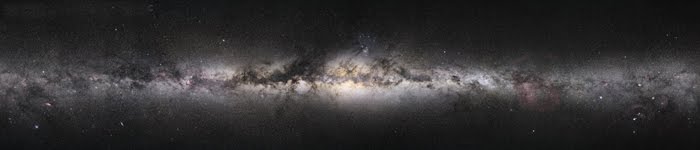
The Milky Way image is under a Creative Commons Attribution-Share Alike 2.5 Generic license. Its author is Digital Sky LLC.

Sunday, May 09, 2010

Saved by Relativity

Coming at you from space, flying close to the speed of light, about 1 muon passes through your head every second. Probably not the best thing for your health, but also not enough to really harm you.
image from nsf.gov / J. Yang
Muons happen to be very unstable: their half-life is near 1 millionth of a second (microsecond or μs). 100 muons become 50 in 1μs and 25 in another. They decay so fast that if every particle in the universe were a muon, within 1 millisecond (1000μs) they'd all be gone!

These muons fly toward Earth at near the speed of light, at about 1000 ft/μs. So, if every second 1 muon goes through your head on Earth's surface, calculations show (due to their decay) 2 should go though your head at 1000 feet, 4 at two thousand feet, and 2^30 at 30000 feet -- that's over 1 Billion muons, enough to kill you instantly!

But planes fly at 30000 feet all the time. So where did we go wrong?

To figure that out, we need some relativity. The special theory of relativity postulates that the laws of physics are the same in all inertial (not accelerating) reference frames and that the speed of light is always constant. Its consequences include:
  1. Moving clocks appear to go slower to stationary observers.
  2. An observer will measure the length of a moving object as shorter in the direction of its relative motion.
  3. E = mc^2 (which we don't need for this problem).
The first two of these consequences have a noticeable effect only at very high velocities and a strong effect at near the speed of light.

Remembering that muons travel fast enough to experience relativistic effects, it becomes clear what's going on. From our point of view they decay (what turns out to be) 10x slower. So instead of 30 halvings, we only see them go through 3. At 30000 feet only 2^3 = 6 muons per second go through your head, and you can survive that just fine!

This just leaves one puzzle: from the muons' reference fames it is our clocks that slow down, not their own. How do we explain them halving only thrice between airplane height and the Earth's surface from their point of view?

This post is inspired by a 2002 Princeton physics lecture by Peter Meyers. A similar story appears on the Stanford SLAC website.

Update (5/11/10): my following post answers the muon riddle.